
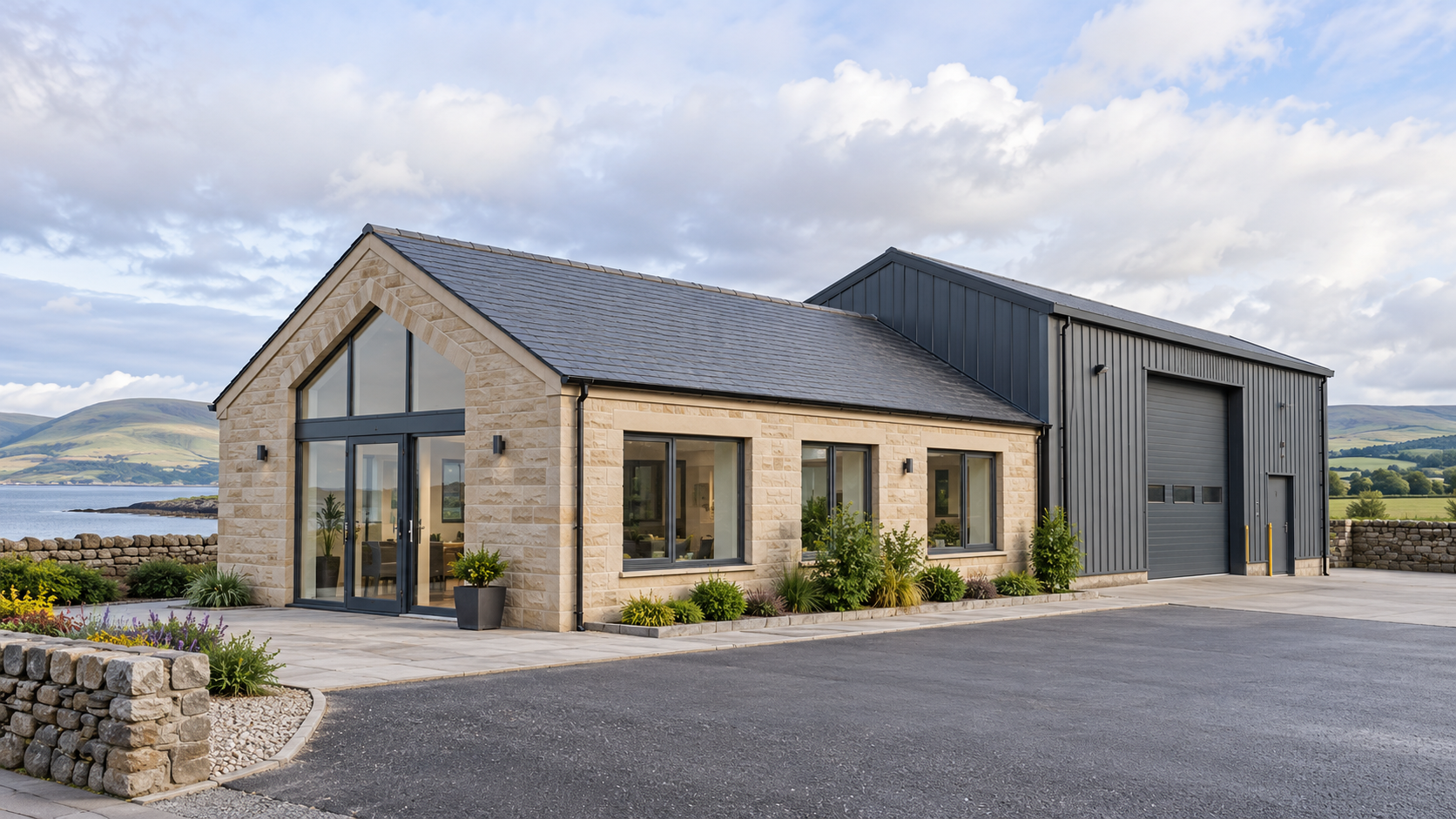
Buying your own premises can be an important step for an established business. You might want more control over your working space, room for equipment, or a permanent base close to your customers. For business owners in Ayrshire, the starting point is a practical question: can the business comfortably afford both the building and everything it needs to keep trading?
An owner-occupied commercial mortgage can help finance premises used by your own business. The right arrangement depends on the property, your trading position, available cash and longer-term plans. Comparing the mortgage payment with your current rent is useful, but it is only one part of the decision.
This guide explains what to consider before buying commercial premises in Ayrshire, from the initial budget to lender preparation and Scottish property costs. The same planning principles apply if you are also considering a move or additional premises in Glasgow.
What is an owner-occupied commercial mortgage?
Owner-occupied commercial mortgages are used to finance property from which the borrower's business operates. Healthcare businesses such as dental surgeries are often assessed on practice income as well as the building; see our guide to dental practice finance in Ayrshire. That could mean an office, workshop, shop, warehouse or other suitable commercial building. Commercial investment mortgages serve a different purpose: financing property that is let to tenants.
For the funding basics, see the owner-occupied commercial mortgages service guide. The proposed occupation and repayment source need to be clear. If your business will use one part of a building and let another part, explain that from the outset. A lender needs the full picture rather than a simplified description that changes later.
Commercial mortgages are secured borrowing. The lender will assess the business and the property, and the agreed security can be at risk if repayments are not maintained. Before proceeding, establish who will borrow, who will own the building and which business will occupy it. Your accountant and solicitor should help assess the ownership structure and its consequences.
Start with how the premises will support your business
A good property search begins with operational needs. An attractive building is of limited value if deliveries are difficult, customers cannot access it conveniently or the layout makes your work less efficient.
Write down the essentials before viewing premises in Ayrshire. These might include customer parking, loading space, reliable connectivity, sufficient power, storage, accessibility or room to expand. Separate requirements from preferences so that a lower purchase price does not distract from an expensive practical compromise.
Location should also reflect how your business works. An appointment-based business in Ayr may prioritise convenient customer access. A workshop search around Kilmarnock may place more weight on yard space and vehicle movements. An Irvine office search might focus on staff travel and adaptable rooms. These are questions to investigate at each property, not assumptions about what any town can offer.
If Glasgow is another option, compare the same operational checklist across both locations. Include the effect on existing customers and employees, rather than comparing asking prices alone.
Buying versus renting: compare the full commitment
Ownership can give a business a more permanent base and the opportunity to build equity as borrowing is repaid. It also ties up money that might otherwise support recruitment, stock or new equipment. Property values can fall, and selling a specialised building may take time.
Prepare a side-by-side budget for continuing to rent and purchasing. On the ownership side, include mortgage payments, maintenance, insurance, professional fees and any estate or shared-area charges. On the rental side, check your actual lease responsibilities rather than assuming the landlord pays every repair bill.
Think about flexibility too. If you expect a major change in staffing, production or location, how well will the building cope? Would you still want it if growth were slower than planned?
For an Ayrshire business considering its first purchase, a useful test is to explain the business benefit in one paragraph without mentioning potential property appreciation. That keeps the decision grounded in trading needs rather than an uncertain future sale price.
Build a purchase budget that protects working capital
Your deposit is only part of the cash requirement. Ask for a budget that separates the property price, borrowing, acquisition costs, fit-out expenditure and the reserve needed after completion.
Potential costs include lender arrangement fees, valuation fees, legal work, searches, registration, tax, moving costs and essential repairs. Find out which costs are payable before a final lending decision and whether any remain payable if the purchase does not proceed.
There is no universal deposit percentage for all commercial mortgages. My guide to how much deposit you need for a commercial mortgage in Scotland explains how lenders set loan to value and what pushes the figure up or down. A lender's published guide is a starting point, not confirmation of what your business can borrow. The property, valuation, business performance, security and individual lender criteria can all affect the proposal.
For illustration only, a £300,000 purchase with a £210,000 loan leaves £90,000 of the price to fund yourself. That simple subtraction excludes fees, taxes, works and reserves. It is not a lending offer or an indication that this borrowing level would be available.
Keep a separate cash-flow forecast for trading. Using every available pound to complete a purchase can leave the business exposed to an ordinary late customer payment or unexpected repair.
Check the Scottish costs before agreeing your budget
Commercial property purchases in Ayrshire fall within Scotland's Land and Buildings Transaction Tax system, commonly called LBTT. Do not use an England-only stamp duty calculator for a Scottish purchase.
Revenue Scotland currently lists non-residential purchase bands of 0% on the first £150,000, 1% on the portion from £150,001 to £250,000, and 5% on the portion above £250,000. These bands were checked on 10 October 2026. For a straightforward purchase with £300,000 of chargeable consideration and no relief, that produces £3,500 of LBTT. Your solicitor should confirm the actual treatment, particularly where VAT, linked transactions or residential accommodation are involved.
VAT also needs an early answer. A commercial property transaction may carry VAT, including where an option to tax applies. Ask your accountant and solicitor whether VAT is payable, how it affects the completion funds and whether recovery is available in your circumstances. Do not treat a possible later recovery as money already available to complete.
Non-domestic rates are a separate ongoing cost. Check the property's rateable value and the likely bill with the relevant council. Any relief needs to be established for your circumstances; the seller's current bill is not a promise of what you will pay.
Prepare the trading story as carefully as the paperwork
A commercial mortgage application should make it easy to understand what the business does, how it earns money and why the purchase makes sense. A collection of accounts without an explanation of the move can leave important questions unanswered.
Prepare recent financial accounts, up-to-date management information, business bank statements and details of existing borrowing. Requirements differ between lenders, so confirm the document list before commissioning additional reports. Be ready to explain deposit funds and any significant recent changes in trading.
Your forecast should connect the purchase with real operating assumptions. If extra space is expected to increase sales, explain the capacity change, customer demand and costs needed to deliver it. Distinguish existing contracted work from enquiries and ambitions.
Seasonality deserves attention. If your Ayrshire business has quieter months, show how it will meet payments during those periods. Include the moving period, when costs may increase before the new premises contribute fully. Clear explanations of weaker periods are more useful than forecasts that quietly assume every month will improve.
Test affordability beyond the headline monthly payment
A mortgage can look manageable in an average month while putting pressure on the business at other times. Build a realistic forecast that includes existing debt commitments and ordinary trading expenses as well as the proposed property costs.
Then test changes. What happens if a large customer pays later, turnover is lower or a repair is needed soon after completion? How much breathing room remains if borrowing costs increase under a variable-rate arrangement or when a fixed period ends?
Fixed and variable commercial mortgage options have different implications. A fixed rate can provide payment certainty for the agreed period, while a variable rate can change in line with its contractual basis. Ask how repayments work throughout the facility, including any period after the initial rate expires.
Compare total costs and restrictions alongside the interest rate. Check fees, overpayment rights, early repayment terms and whether a balance remains to be repaid at the end. The most useful comparison is between complete written proposals based on the same borrowing requirement.
Give the building its own due-diligence checklist
A lender's valuation serves the lender's purposes. Ask what it covers and obtain appropriate independent advice about the building's condition and suitability. A valuation should not be treated as a comprehensive survey or confirmation that every proposed activity is permitted.
Before buying commercial premises in Ayrshire, investigate the roof, drainage, utilities, access and any significant repair requirements. Ask your advisers about relevant environmental matters, including historic site use or flood exposure where appropriate. The point is to identify issues and their costs before they undermine the purchase plan.
Check the intended use with the planning authority and ask about any permissions or building warrants needed for proposed works. Ownership does not remove planning requirements. If you are buying a shared building, establish rights and responsibilities for common areas, access routes and maintenance.
Your solicitor should also investigate the title and any existing occupational arrangements. If the building is occupied, clarify how and when your business can move in. Do not organise a firm relocation date around an assumption of vacant possession.
Agree ownership and security arrangements early
The trading company does not automatically have to be treated as the only possible property owner, but alternative structures require advice. The borrower, owner, occupier and any guarantor need to be identified clearly before applications and legal work become advanced.
Ask your solicitor and accountant to explain the implications of the proposed structure for tax, occupation, future sale and business changes. Avoid selecting an arrangement simply because another business owner uses it. Their ownership, borrowing and succession plans may be different.
Security deserves a separate discussion. Establish exactly which assets are being offered and whether personal guarantees or additional security are requested. Read the scope, limits and release conditions with an appropriate legal adviser. A limited company structure should not be assumed to remove every personal exposure when guarantees are involved.
This becomes particularly important if an Ayrshire business is also considering premises in Glasgow. A second purchase should be assessed alongside existing borrowing and security, so that the owner understands how the commitments interact.
Where do bridging loans and development finance fit?
A straightforward purchase of suitable premises may be considered for a commercial mortgage from the outset. A property needing substantial work, a change of use or a particularly demanding purchase timetable may need a different funding discussion.
Bridging loans are short-term borrowing. If a bridge is proposed, understand why it is needed, its full cost and the evidence supporting repayment. An intention to obtain a commercial mortgage later is not the same as an approved refinancing facility. Consider what would happen if works, trading performance or the valuation prevented refinancing as expected.
Development finance may be relevant to a construction or substantial redevelopment project. The funding assessment can involve the scheme, permissions, cost plan, delivery team and how borrowing will ultimately be repaid. Describe the proposed works accurately so that the funding route matches the project.
A business finance broker can also help you consider the wider funding requirement. Property borrowing, equipment and working capital have different purposes. Taking several facilities without checking the combined repayments and security can create avoidable pressure.
What should a commercial mortgage advisor help you understand?
When choosing a commercial mortgage broker, ask how they assess your requirements, which lenders they consider and how their service is paid for. Establish any broker fees, when they become payable and whether lender commission is received. These should be clear before you commit to the service.
A useful conversation should cover the property, the business, available cash, timing and potential difficulties. Bring up unusual circumstances early, including mixed use, planned works, previous credit problems or a recent change in ownership. These details can affect which options merit investigation.
Regulatory treatment must also be checked for the actual arrangement. Lending secured solely on business-use premises generally falls outside the FCA's regulated mortgage contract definition. Mixed-use property, residential security, borrower type and applicable exclusions can change the analysis. Do not assume that every product called a commercial mortgage has the same protections as a residential mortgage.
Ask what protections and complaint routes apply to your particular finance and service. The firm's regulatory status and the status of the individual transaction are separate questions that deserve clear answers.
Plan the route from viewing to moving in
An organised purchase needs the business owner, finance contact, solicitor, accountant and property professionals to work from the same information. Share the proposed purchase price, occupation, ownership structure, target dates and any works consistently.
Before committing, work through these five readiness checks with your advisers:
- Property fit: have you checked access, condition, permitted use and any works?
- Cash: are the deposit, tax, fees, fit-out and trading reserve covered?
- Affordability: does the forecast remain workable if trading or borrowing costs change?
- Finance and legal position: what conditions remain, and when do commitments become binding?
- Move: can the occupation date, existing lease and fit-out programme work together?
In Scotland, take advice from your solicitor about when missives become binding and what conditions are needed to protect your position. An indicative finance discussion or agreement in principle should not be treated as unconditional money available for completion.
Before moving an Ayrshire business, check the existing lease timetable, fit-out programme, supplier arrangements and potential overlap in occupation costs. Give responsibility for each outstanding item to a named person. A short shared checklist can be more useful than a target date that nobody has tested against the work remaining.
Discuss your Ayrshire premises plans with Catherine McNiven
Buying business premises deserves a finance discussion before the property timetable begins driving every decision. Bring a clear outline of the building, purchase price, available deposit, trading position, proposed works and preferred timing.
If you are considering commercial mortgages in Ayrshire, contact Catherine McNiven to discuss your plans and the information needed to explore suitable funding. If your search also includes Glasgow, explain how each location would support your business so that the discussion starts with your priorities.
Whether the initial question involves commercial mortgages, bridging loans, development finance or wider business finance, the aim is a well-understood funding plan with realistic costs, manageable commitments and enough cash left to run the business.
This article provides general information, not a personal financial, legal or tax recommendation. Finance is subject to assessment and lender criteria. Property and other assets used as security may be repossessed if repayments are not maintained. Obtain advice appropriate to your circumstances before committing.